Comp Card Size: Standard Dimensions, Formats and What to Use

If you are about to print a comp card, the first question is usually the size. It is a fair question with an unsatisfying answer: there is no single standard. The right size depends on where you are, who you are sending the card to, and whether you are printing it at all.
This guide explains the common sizes, how to find out what a particular agency wants, and why a digital card removes most of the problem. If you are still working out what goes on the card, start with what to put on a comp card.

There is no single standard comp card size
Search for the standard comp card size and you will find several confident answers that disagree. That is because the industry grew up in different countries with different paper sizes, and agencies have their own habits. Some prefer a small card that fits in a bag or a pocket. Others prefer a full sheet that looks like a composite from the agency's own book.
What is common is that cards are portrait or landscape sheets of ordinary paper formats, not odd custom shapes. Printers and copy shops can cut them quickly because they use sizes they already stock.
The sizes you will see most
The sizes below are the ones you are most likely to meet. Treat them as a guide, not a rule.
- Half letter, about 5.5 by 8.5 inches. A small card that is easy to carry and hand over. It is a long-standing choice in the United States.
- Letter, 8.5 by 11 inches. A full sheet. It gives photos room and prints on any home or office printer.
- A5. The nearest metric match to a half sheet, common in countries that use A-series paper.
- A4. The full-sheet standard in most of the world. It prints anywhere and fits a folder.
- Folded cards. Some cards fold, with photos on the outside and details inside. They are less common now, and they cost more to print.
If you are making only one version, a full sheet in the paper size your country uses is the safest. It prints on any printer, and it can be shrunk to a smaller card later without losing anything.
How to find out what an agency wants
Agencies publish what they want from new applicants, usually on a submission page. Most ask for digital photos and basic details first, and many do not ask for a comp card at all until you are signed, because they make their own.
So the best way to choose a size is to read what the agency says. If a page does not mention a card, you can assume it is not needed at this stage. Our guide to submitting to modeling agencies explains what most agencies ask for and in what form.
When the size actually matters
The size matters in three situations:
- You are handing out printed cards at castings. A card that fits in a pocket or a folder is easier to carry and easier for the other person to keep.
- You are sending a file that will be printed. If an agency or client will print your card, a standard paper size avoids odd margins and cropping.
- You are making a card that will be pinned up. A composite on a board is read from a distance, so a larger sheet and larger photos help.
For almost everything else, the size is irrelevant, because most people will look at your card on a screen.
Resolution and bleed for printing
If you do print, two technical details are worth knowing.
Resolution. Photos need enough pixels to print sharply. As a rule of thumb, aim for around three hundred pixels for every inch of print. A photo that looks fine on a phone can look soft on paper if it is small.
Bleed and margins. If your design has an image that runs to the edge of the page, the printer usually needs a small extra margin that gets trimmed off, called bleed. Keep names and numbers away from the edges, so nothing important is cut.
Ask the printer what format and bleed they want before you pay for a run. A short conversation saves a reprint.
Why a digital comp card avoids the problem
A digital comp card has no fixed size. It adapts to a phone, a laptop or a large screen, and it can be saved as a PDF at whatever page size you need. If a booker wants it printed, they can print it themselves.
That also means one card can serve every situation. You send the link by email, show the QR code at a casting, and save the PDF if someone asks for paper. If you change a photo, the link updates for everyone who has it. We compare the two approaches in digital comp cards.
FYND saves every design as a clean PDF sized for A4, with your photos, details and QR code, so you can print a card on any ordinary printer. You can look at the layouts on the designs page before you choose one.
Which size should you choose?
Here is a short way to decide.
- If you are only sending your card online, you do not need to choose. Use a digital card.
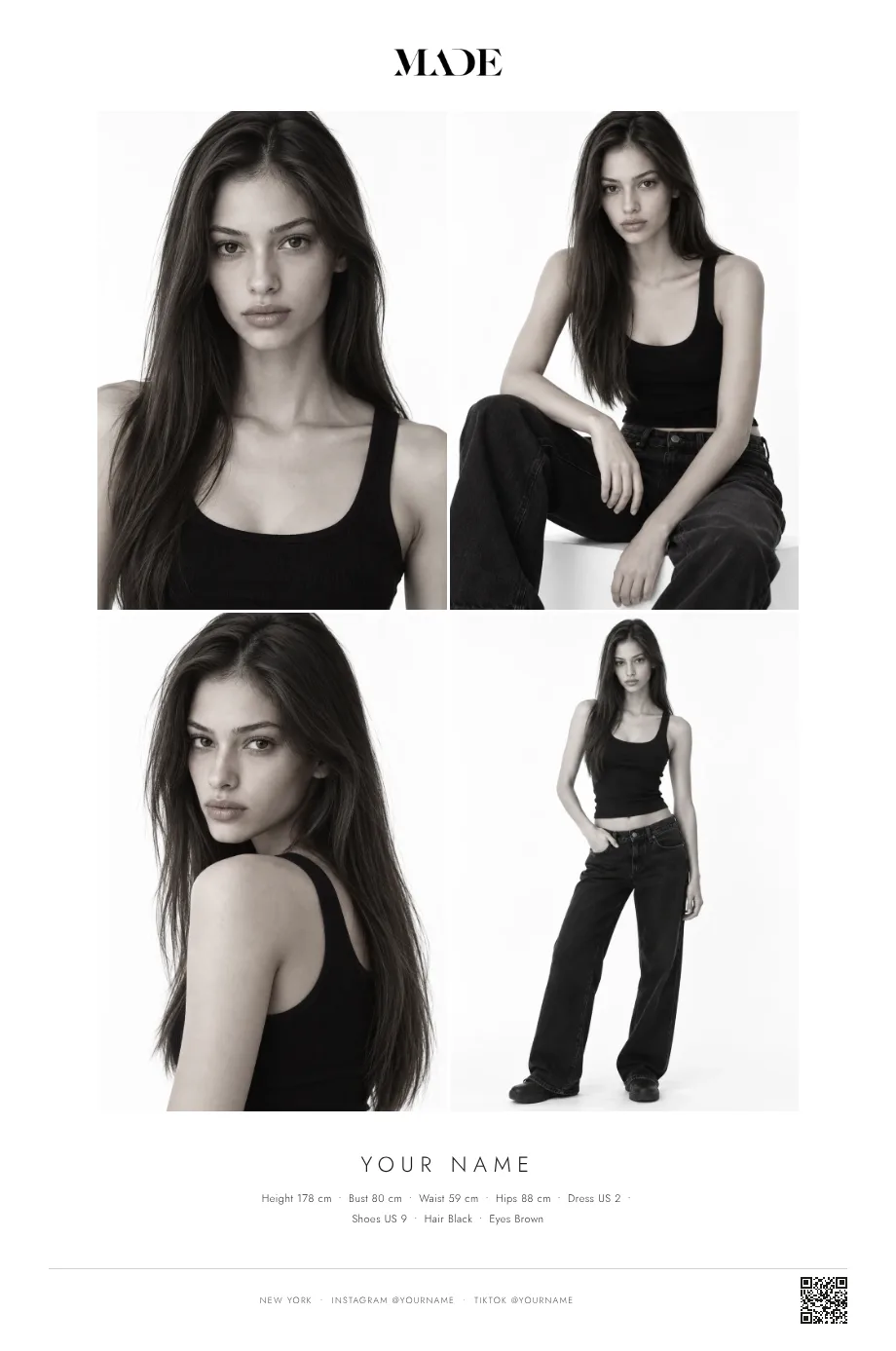
- If you want a printed card for castings, use a full sheet in your country's paper size, and print it on good paper.
- If an agency states a size, use that.
- If you are not sure, ask. A short email to the agency's booking team costs nothing.
Comp card sizes vary by country and agency, so there is no single answer. A full sheet in your country's standard paper size is the safest print choice, and a digital card that saves as a PDF makes the question mostly disappear. Choose your photos and details first, then size the page to suit. When you are ready, build your free comp card.
To see everything FYND offers talent, visit the talent features page.
Frequently asked questions
What is the standard size of a comp card?
There is no single standard. Common sizes include half letter, letter, A5 and A4, depending on the country and the agency. Check what the agency you are applying to prefers.
Can I print a comp card at home?
Yes, on any ordinary printer, as long as the photos are sharp enough. For a handful of cards, plain heavy paper is fine. For a larger run, a print shop will give a better finish.
Should a comp card be portrait or landscape?
Both are used. Portrait is more common, because photos of people are mostly portrait. Landscape works if you want a row of photos side by side. Choose the orientation that shows your photos best.
Do I need to print a comp card at all?
Often not. Most agencies and clients look at cards on a screen. A printed card is useful at castings, or when someone asks for one, and a digital card that saves as a PDF covers that.
What resolution should my photos be?
For print, around three hundred pixels per inch at the printed size is a good target. For screens, a photo a couple of thousand pixels on its long side is plenty.