What Is a Comp Card? What It Is, What Goes on It and Why Agencies Ask for One


If you have started looking into modeling, acting or any kind of casting work, you have probably been told to "get a comp card" without anyone explaining what that means. It sounds like jargon, and it is, but the idea behind it is simple.
A comp card is a one-page summary of a person's look. It holds a handful of photographs, the measurements a booker needs, and a way to reach you. Agencies, casting directors and clients use it to decide in seconds whether you are worth a closer look, and to remember you afterwards.

A comp card is a model's one-page résumé
The name is short for composite card. The first cards combined several photographs of the same person on a single printed sheet, so a booker could see range without flicking through a folder of prints. The format stuck even as the printing did not: today most comp cards are digital pages that you share with a link or a QR code.
Think of it as the shortest honest answer to two questions: what do you look like, and how do I reach you? It is not an art piece and it is not a full portfolio. It is a working document, and its job is to be quick to read.
A good card does three things at once. It shows your look clearly, it gives the facts a booker needs to picture you in a job, and it makes the next step obvious. Everything else on the page is there to support one of those three jobs.
What is on a comp card
Most comp cards follow the same pattern, because the people reading them want the same information in the same place:
- Photos. Usually between four and six, chosen to show range: a clean headshot, a full-length shot, a profile or three-quarter angle, and one image with more personality.
- Your name. Large, simple and spelled the way you want to be booked.
- Measurements. Height, bust, waist and hips for women's work, chest, waist and inseam for men's work, plus dress or suit size, shoe size, hair and eye colour.
- Contact details. An email address, a phone number if you want one, and your agency's details if you have an agency.
- Optional extras. A location, social handles, a short list of work, and a QR code that opens the digital version.
Our guide to what to put on a comp card goes through each item and the mistakes that make a card harder to read.
Who asks for a comp card, and when
Several people in the industry use comp cards, in slightly different ways.
Agencies look at them when you submit and when they are deciding whether to invite you in. A new agency will often want digital photos first, so a comp card is rarely the only thing you send, but it is useful as a tidy summary alongside them. Read how to submit to modeling agencies before you send anything.
Casting directors and clients collect cards at castings, and many keep them on file. After a busy day of auditions, a card is what jogs a memory.
You, as a talent, use it as your handout. It is what you give a photographer you want to work with, or link to in an introduction email, or put in a message when someone asks "do you have a card?"
Agencies also make their own cards for the people they sign, using their own photos and layout. That is why a first card made by you is a stepping stone, not a permanent object.
Comp card, portfolio and digitals are three different things
New models often mix these up, and the confusion costs them time.
A comp card is a single page that sums you up. A portfolio is a larger collection of your best work, built up over time, and usually shown to clients who want to see how you look in finished images. Digitals, sometimes called polaroids, are simple, unretouched photos that show your natural look, and agencies ask for them first because they are the most honest.
If you only have time to do one thing, do digitals. If you want to understand the difference in detail, see comp card vs portfolio and how to take modeling digitals.
Do you need a comp card before you have an agency?
You do not need one to start. Plenty of people begin with nothing more than a few clear phone photos sent to an agency. But a simple, clean comp card is worth having early, for three reasons.
First, it forces you to choose. Picking four or five photos that show range is a useful exercise in itself, and it shows you at a glance what you are missing.
Second, it makes you easy to pass along. When someone says they know a photographer or a casting director who might want to see you, a link is much easier to forward than a folder of files.
Third, it looks organised. A bad card is not harmful, because nobody expects a perfect one at the beginning, but a clear one tells a booker that you take this seriously.
Printed or digital?
Printed cards still exist, and you will see them at some castings. For almost everything else, a digital card wins. It can be updated whenever your photos or measurements change, it costs nothing to share, and it can carry more than one page of information when that helps. A printed card goes out of date the day your hair changes.
The best of both is a digital card that also saves as a clean PDF, so you can print it when someone asks. We cover the trade-offs in digital comp cards.
What makes a comp card good
A good comp card is boring in the right way. The photos are recent and look like you today. The layout leaves plenty of white space. The text is short and correct. Nothing is hidden behind decoration.
Pay particular attention to honesty. If your measurements or your look do not match the card, the booker finds out at the first meeting, and that costs you more than a plainer card would have. Use real numbers, recent photos and a name that matches your other profiles.
How to get a comp card for free
You can build one in a design tool, in a document editor, or with a service made for it. FYND gives talent a free digital comp card with seven designs, from a classic one-page layout to a poster-style card with your name set large. You add your photos and details, pick a design, and share the link or the QR code. You can change the design at any time and the link stays the same, so a card you have already shared updates by itself.
You can see all the layouts on the designs page, or look at a finished example such as the Classic comp card before you start. When you are ready, create your free comp card.
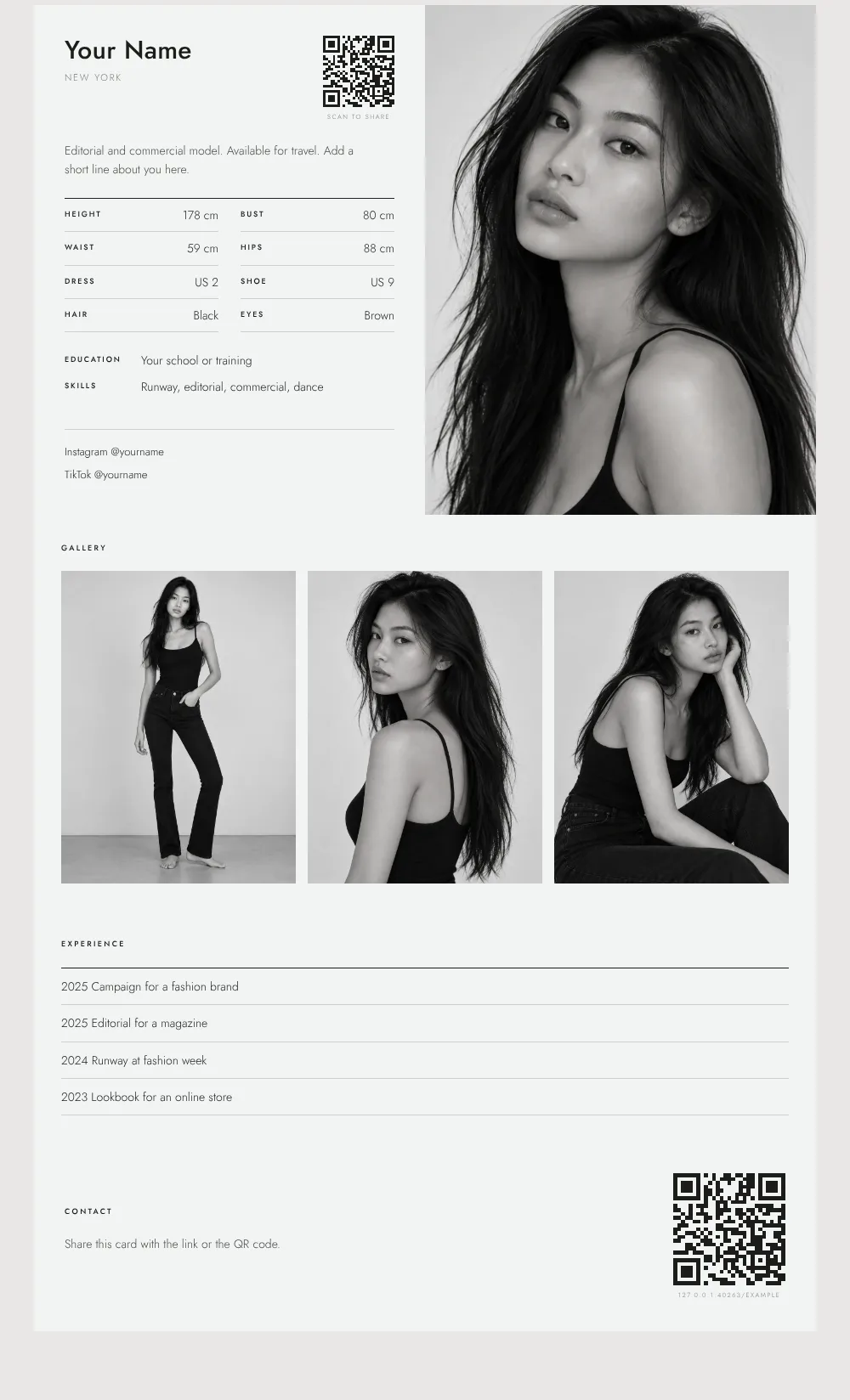
A comp card is a one-page summary of your look that makes it easy for an agency or client to see you and reach you. You do not need an agency to have one, and you do not need to pay for one. Choose a few honest photos, add accurate details, keep the layout quiet and share it by link.
To see everything FYND offers talent, visit the talent features page.
Frequently asked questions
What does comp card stand for?
Comp is short for composite. Early cards combined several photographs on one sheet, and the name stayed even though the cards are now often a single digital page.
Is a comp card the same as a headshot?
No. A headshot is one photograph of your face. A comp card is a page that includes several photos, your measurements and your contact details. A headshot may be one of the photos on it.
How many photos should a comp card have?
Most cards use between four and six. That is enough to show range without making the card slow to read. Agencies and countries differ a little, so check what the agency you are applying to prefers.
Do actors and other talent use comp cards too?
Yes. Actors, dancers, influencers and other performers use them as a quick summary, although the details shown vary by field. An actor might list training and credits where a model lists measurements.
Can I make a comp card myself?
Yes. You can make one yourself in a design tool or with a free service, and many people do. What matters is that the photos are recent, the numbers are real and the layout is easy to read.